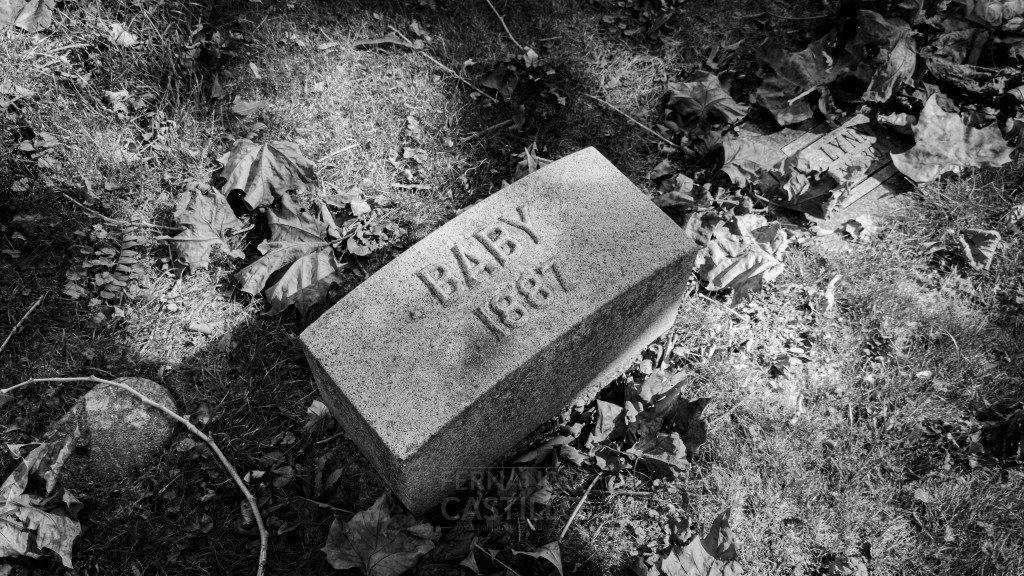
(A Walk Through Graceland Cemetery & Arboretum Part II)
By Fernando Castillo
I found a group of very strange headstones as we continued our tour through Chicago’s Graceland Cemetery & Arboretum. There is only one word engraved in German on these small rectangular stones: Mutter or Vater. Others just have the word Baby in them, Mother, Father, and Baby.
However, what does the fact that there is no name on the stone tell us about the person whose life and memory it holds? Although it is globally recognized for its dazzling skyscrapers—and for the tenth time recognized as the best big city in the United States in Condé Nast Traveler’s Readers’ Choice Awards— Chicago is renowned for its deep migratory dynamics, which have historically served as a welcoming point for communities from all over the world.
Mutter, Vater, Baby: A Single Word for Eternity
These three words conceal a tale that is both heartbreaking and illuminating. The way people used the word «Baby» was affected by the economy and the fact that people died every day. Diphtheria, scarlet fever, and cholera outbreaks in the late 1800s caused a lot of babies to die. Because of this, many families didn’t give their babies names until they were sure they would live.
To this early grief was added a purely practical problem: the cost per letter. For the working-class immigrants who inhabited Chicago’s industrial neighborhoods—many of Germanic descent—the cost of engraving a family member’s full name, birth and death dates, or an epitaph was an unimaginable expense.
Consequently, the practice of carving Mutter or Vater not only enabled them to preserve their native language as the final memory of their identity in a foreign land, but it also saved them significant costs at the stonecutter’s workshop.
The Role of the Supreme Family
Inscribing those three words can also mean something deeper than just money or the death of a loved one: the person’s role in the family. That title had a greater meaning in the day-to-day context of the time than the name listed on immigration documents.
In their most basic form, the words Mutter, Vater, and particularly Baby eliminated their status as common nouns and instead became a universal grief that does not require dates or surnames.
I know that the people who run each cemetery keep records of exactly who is buried under which unnamed headstone, but if no one ever asks, that person’s life on earth is summed up in a single word—a touching testament that has stood the test of time out of necessity or grief.
Dear Reader, in a time when we are surrounded by screens and perfect social media profiles and digital conversations that want to make a difference, the simplicity of these small time capsules can teach us how to be humble.
At the end of the road, when time wears away dates and worldly titles, names become irrelevant. And perhaps, just perhaps, the only thing that truly matters is the primordial bond that connects us to others: having been a father, a mother, or a child.
Not even the most modest stone is colder, nor are the most monumental mausoleums warmer. A single word that cherishes all the love we were able to leave behind is sufficient to be remembered forever.




Deja una respuesta