By Fernando Castillo*
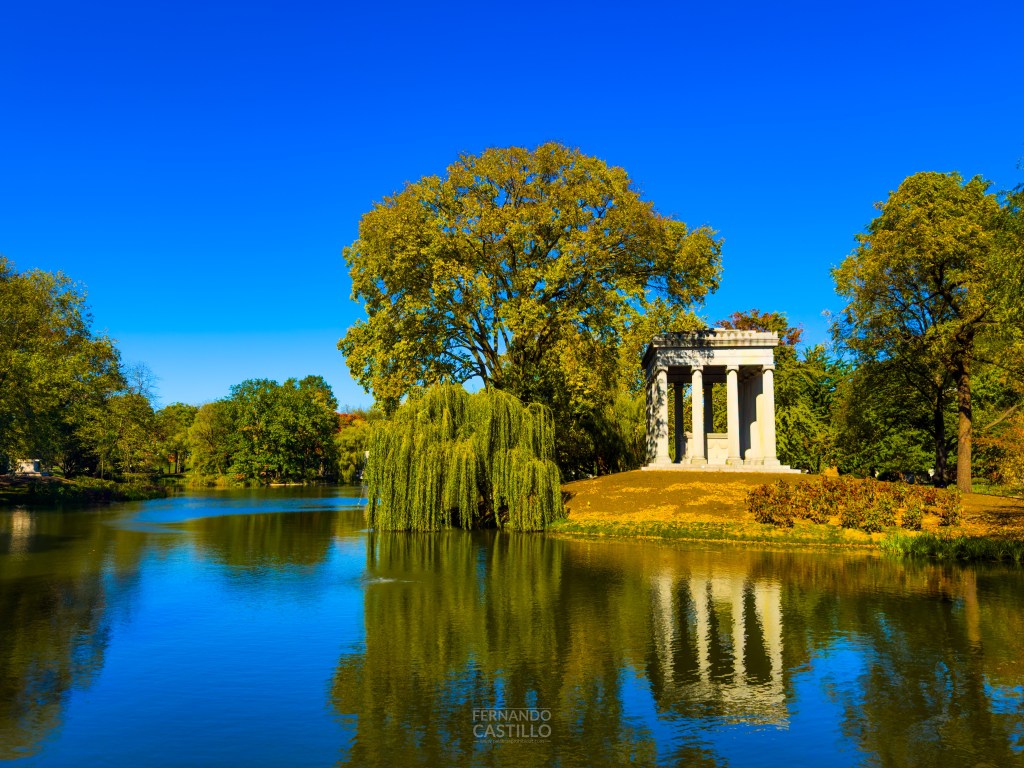
Last weekend, I went on a tour of Graceland Cemetery & Arboretum, which is one of the most beautiful, historic, and interesting places in Chicago. In 1860, Thomas Bryan established a Victorian garden cemetery that was initially devoid of the substantial brick perimeter walls that currently encircle it. In the early years, the area was just a wide, quiet, rural area on the edge of Chicago.
The iron fences and stone walls enclosing individual family plots were removed by landscape architects H.W.S. Cleveland and Ossian Simonds ten years later, in the 1870s, revolutionizing cemetery design. As their main goal, they wanted to make a landscape that looked like a public park and was uninterrupted.
As you walk through its winding wooded paths and peaceful lakes, you can’t help but notice an interesting paradox: the people who came up with the ideas for Chicago’s modern skyline are sleeping here. Here are the graves of famous people like Daniel Burnham, Louis Sullivan, and Marshall Field, whose business and building empires changed the city after the terrible fire of 1871. The people who built huge steel structures and business dynasties are now resting in peace, a somber reminder that even the biggest dreams come to an end in the end.
The Dickens Connection to Chicago
But Graceland is more than just a shrine to industrialists; it also holds stories of people who are incredibly weak. The tomb of Augustus Newnham Dickens and his family is tucked away in a quiet place. In fact, my esteemed reader, we are discussing the younger brother of the renowned British novelist Charles Dickens.
Augustus lived in Chicago, far from his brother’s public life, after fleeing England during a personal scandal. In 1866, his life was quietly brought to a close in Illinois, amidst tragedy and neglect, leaving behind a narrative that transcends the confines of a mere family footnote.
His body was interred in an anonymous plot without a headstone for more than six decades. Augustus provoked a significant period scandal in 1857 by abandoning his lawful wife, Harriet, who had tragically lost her sight, in order to emigrate to the United States with his lover, Bertha Phillips. In Chicago, the couple established themselves as «Mr. and Mrs. Dickens» and introduced themselves to the local community.
Augustus tried to rebuild his life in Chicago by working as a merchant and a clerk for the Illinois Central Railroad. However, his days were dominated by growing debt and a recurring struggle with alcoholism. He died of tuberculosis on October 4, 1866, when he was 38 years old. The terrible news didn’t end there; Bertha died of a morphine overdose not even two years later.
Charles Dickens kept a strict personal distance while secretly showing compassion when he was in danger of being shamed in public. The author, in complete secrecy from England, sent consistent stipends to fund the orphaned children of Bertha and Augustus in Chicago and his abandoned sister-in-law in London.
The Art of Not Being Forgotten
Graceland Cemetery was the final resting place for Augustus, Bertha, and three of their infant children who passed away. That grave was left completely unmarked for over sixty years, a forgotten scar in the grass.
The Mehaffey and Kasper families, Augustus’s descendants, teamed up with the Dickens Fellowship, an international organization of the author’s fans, in the early 2000s to raise money and create a monument that would honor him. Formal fundraising for the project began in 2003 and continued until 2004. On September 25, 2004, the monument was officially dedicated at the cemetery. However, some sources say that the whole process, including the final, secure placement of the structure, wasn’t fully finished until around 2005. To make sure the author’s brother—and his family’s Chicago history—would not be forgotten, a stone memorial was erected.
In the present day, the grave continues to be a frequently visited destination during cemetery tours. The stone of Augustus reminds us that behind the brilliance of literature’s greatest names lie broken lives, conflicting devotions, and scandals that might otherwise remain undiscovered.
Bachelor’s Degree in Linguistics from the University of Colima. Write to me at lcastilloochoa@gmail.com or visit http://www.palabrasprohibidas.com to read more.





Deja una respuesta