
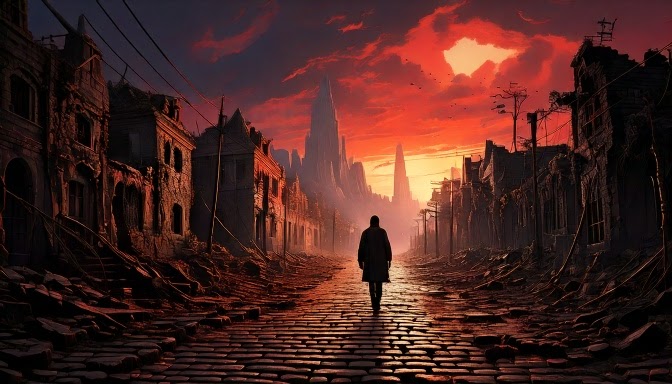
I find myself in a world devastated by silence. I am the last living being on the planet. Around me lie ruins, deserted streets, and a sky painted in crimson hues with black clouds. Humanity has vanished—and I don’t know how I got here. I walk along an old cobblestone street. The wind whistles ghostlike through the debris. All I can feel is the unbearable weight of being the final witness to humanity’s downfall.
Uncertainty devours me, and despair brings me to my knees. Just when it seems that I can’t endure the loneliness and emptiness any longer, I open my eyes and fall into my bed. I realize it was all a nightmare—my mind’s version of a “simulated reality.”
Simulated Realities
Everything we perceive through our senses is translated and processed by the brain via electrical signals. In other words, when we interact with the world, our senses collect environmental information and convert it into electrical impulses carried by neurons—specialized nerve cells— to various brain regions responsible for interpreting and making sense of that input. This sensory processing is essential to our perception of reality.
But what about dreams? You’ve surely experienced sensory experiences in dreams so vivid they felt real. Moments when you simply couldn’t wake up—and afterward, you remember every detail as if it were real.
When we dream, the brain generates images, sensations, and scenarios that appear entirely real, even though they happen only within our sleeping mind. In that sense, dreams are powered by electrical impulses in the brain. The brain remains active during sleep, displaying different patterns of electrical activity. The REM phase is the most notable—when activity closely resembles wakefulness. Not just dreams, but nightmares, too, offer a unique view into the brain’s capacity to fabricate alternative realities that, when we awaken, leave us questioning what’s real.
So, if the reality we perceive is processed via brain signals just like dreams, what truly differentiates what we dream from what we live? Should we call dreams “simulated realities”? Even more intriguing: would it be possible to induce a simulated reality in a human? How might our perception of nature, reality, or identity change? What ethical challenges would arise in a world where simulating reality becomes feasible?

I Think, Therefore I Am
With so much information on the internet—from science fiction, fantasy, philosophy—ideas emerge that push us to question our reality. One compelling idea is that of living in “Simulated Realities,” where human perception and experience could be artificially influenced or even created.
Since ancient times, humanity has sought to unravel the mysteries of existence and the nature of reality. Philosophy and science have both attempted to decipher these questions in an unending quest—and one of these ideas is that our reality may not be what it seems.
The notion that we live in a simulation invites us to challenge the limits of human perception and to ask whether what we experience is truly genuine.
This is no new concept. Throughout history, great thinkers have pondered whether our experience of the world is but an illusion—generated by unknown forces or even by a superior entity. Think of The Matrix.
Chinese philosopher Zhuangzi explored this blurred line in his short tale “The Butterfly Dream.” In that philosophical fiction, Zhuangzi dreamt he was a butterfly, and upon waking, wondered whether he was Zhuangzi dreaming he was a butterfly—or a butterfly dreaming it was Zhuangzi.
French philosopher René Descartes, with his famous declaration “Cogito, ergo sum” (“I think, therefore I exist”), questioned the nature of reality and the certainty of our knowledge. This highlights the human ability to scrutinize our own reality and the authenticity of our experiences—leaning heavily on consciousness and reflection to discern what is real.
In the 20th century, American philosopher Robert Nozick, in “The Experience Machine” (part of Anarchy, State, and Utopia), imagined a supercomputer that could provide a person with fully convincing simulated sensory experiences. This poses the question: could we be living in such a perfect simulation?
However, it was 21st-century Swedish philosopher Nick Bostrom who brought the idea of simulated realities into sharper focus. His famous simulation argument presents a trilemma: at least one of the following must be true:
- The fraction of civilizations reaching a post‑human level capable of running high‑fidelity ancestor simulations is virtually zero.
- The fraction of post‑human civilizations interested in running ancestor simulations is virtually zero.
- The fraction of human‑class simulations that are actual lived experiences is almost one.
If post‑human civilizations both desire and can simulate their ancestors’ lives, then it’s more likely we are living in a simulation than in base reality. This provocative idea has sparked countless debates and theories about the nature of reality and human experience.
Thus, the concept of simulated realities has evolved—from philosophical musings on dreams to advanced theoretical models questioning whether our world is manufactured.
Today, while still hypothetical, this idea compels us to question what we deem “real.”
The Human Mind: Creator of Simulated Realities in Dreams

To grasp the concept fully, we must understand how the human mind can create such convincing fictional experiences. During sleep, the brain constructs vivid dreamscapes that defy the limits of logic and physics. We can reunite with those who have passed or inhabit worlds we’ve never seen—realities woven from our deepest yearning or fear.
These dream experiences stem from neurobiological and psychological interactions. During REM sleep—the stage most associated with dreams—the brain showcases electrical activity akin to wakefulness while disconnecting from the external world. It then prioritizes memory consolidation, emotional processing, and creation of alternate experiences.
Dreams often mimic our emotions, stresses, and unmet desires. Anxiety breeding anxious dreams; longing granting glimpses of fulfillment. The mind weaves illusions, blending the real and the imagined so seamlessly it becomes hard to distinguish them.
So if our brain can generate such immersive experiences during sleep, could advanced entities create simulated realities just as complex in waking life?
False Memories in a Simulated Reality (Hypothetical Memory Manipulation)
If dreams are a form of chemically produced simulated reality, could waking experiences also be manipulated? In a hypothetical future where technology and artificial intelligence have reached unprecedented levels, imagine memories could be implanted or altered—fabricated to feel as vivid as true experience. Think Total Recall (1990), based on Philip K. Dick’s story “We Can Remember It for You Wholesale.”
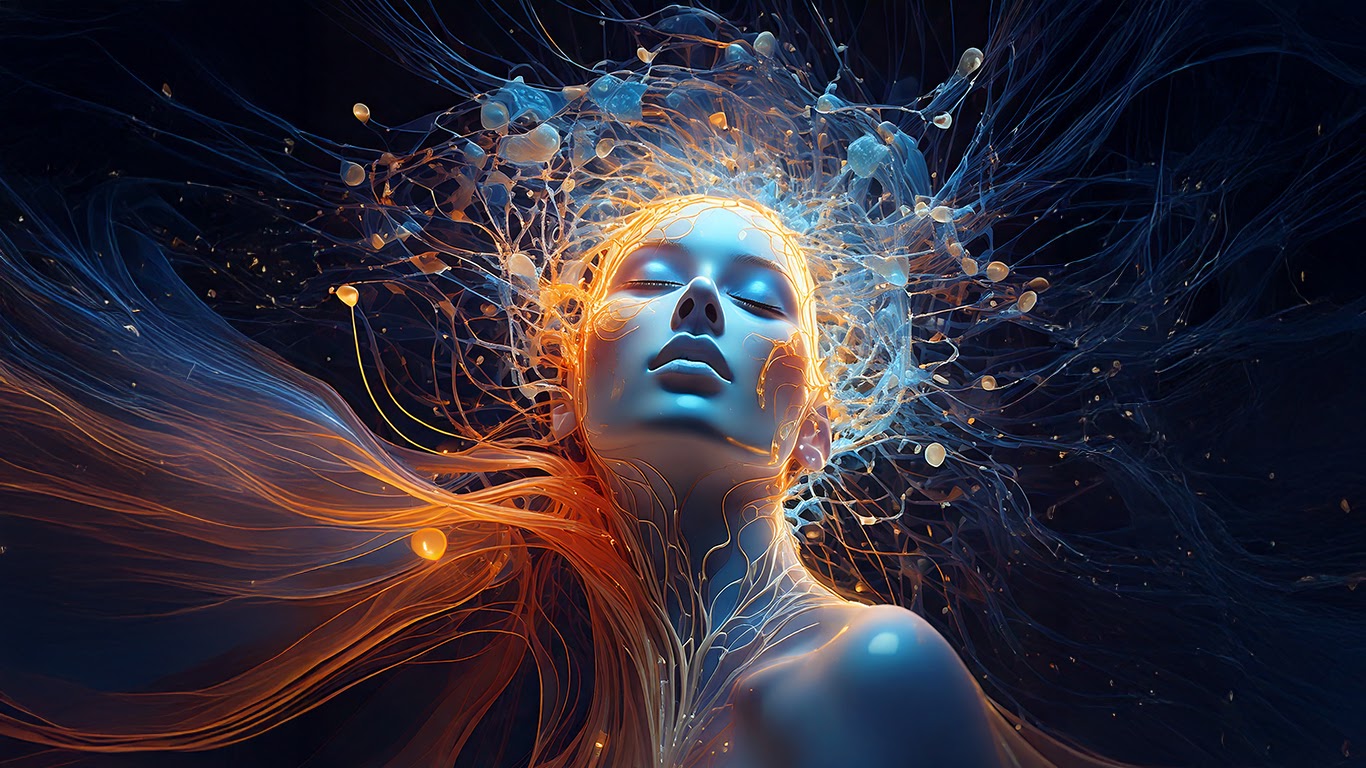
This possibility raises serious ethical questions: What would it mean for our identity if memories could be manufactured? How would that affect our understanding of ourselves and our relationships?
The authenticity of experience and truth would become unstable. Trust in our senses and environment would falter. How then can we distinguish the real from the fake? What foundation remains for building identity and relationships?
Memory manipulation also raises sociopolitical concerns. Could governments alter collective memory to influence public perception of history? What would happen to our ability to learn from the past and avoid repeating mistakes if collective memory becomes malleable?
Even in speculative realms, this idea forces us to confront how fragile perception is and the role memory plays in shaping individual and collective reality. Exploring these possibilities can serve as a window into the complexities of the human mind and the nature of reality.
The Nature of Reality

Setting aside science fiction, if dreams can be as vivid as reality, what is reality itself? How can we be sure our perceptions correspond to objective truth?
Imagine a waking event mirrored in a dream—so vivid that distinguishing them becomes difficult. How can we trust that such experiences remain distinct?
Human perception is inherently subjective—, influenced by culture, beliefs, education, and experiences. Even shared reality doesn’t guarantee shared interpretation.
Introducing «simulated reality» adds layers: if experience can be fabricated, reality itself becomes fluid. News, images, and videos—once reliable—become suspect.
Implications and Real Challenges
Though hypothetical, simulated realities raise real-world issues:
a) Truth & Reality: If experiences can be fabricated, how do we confirm authenticity?
b) Ethics & Privacy: Is it ethical to manipulate memories without consent?
c) Identity & Authenticity: Could we trust our own histories if memories are manufactured?
d) Responsibility: How do we assign accountability if experiences and actions can be simulated?
e) Perceptual Trust: Can we trust sensory data and memories as truthful?
f) Technological Ethics: If simulation becomes possible, how do we safeguard human integrity?
Ultimately, the idea of a simulated reality forces us to rethink reality and personal experience. Even if hypothetical, it echoes in real debates—from deepfakes to synthetic memories.
Society must engage in open, critical dialogue on these matters. From vivid dreams to manipulated media, our perception shapes our world. As humanity advances, the line between real and imagined grows ever more fragile.





 Palabras Prohibidas
Deja un comentario